Building Rally: A Live, Crowdsourced Court Map That Stays Honest
How I built Rally, a gamified, crowdsourced map of 1,450,000+ courts and fields across nine sports worldwide, using an Expo and React Native app on Supabase Postgres with PostGIS, a Cloudflare D1 edge replica for court reads, GPS proof-of-presence check-ins, and server-side-only scoring so the crowdsourced map stays trustworthy.

Rally is a mobile app that shows which courts near you are free right now, across nine sports and more than 1,450,000 courts, pitches, fields, and grounds worldwide. The hard part was never the map. A crowdsourced map is only as good as its worst contributor, so every status report is GPS-verified, a new court needs two independent on-site confirmations before it publishes, and no XP or points are ever minted by the phone. Under the hood it's an Expo and React Native app on Supabase Postgres with PostGIS, fronted by a Cloudflare Worker that serves court reads from a D1 replica at the edge. Live at rally.ahnafnafee.dev.
Why Another Court App
Static directories tell you a court exists. They don't tell you whether you can play on it in the next ten minutes, which is the only question that matters when you're standing there with a racquet. That answer changes by the hour, and it can only come from someone who is physically at the court. So Rally is built around live status, free / busy / full, reported by players on the ground, plus a map the community can correct when a court's details are stale or missing.
The Shape of It
The app is Expo (SDK 56, React Native, expo-router with typed routes, MapLibre for the map, React Query for data). It never talks to the database directly. Every request goes through a small Cloudflare Worker called rally-api, which fronts a Supabase Postgres database and a Cloudflare D1 replica of the court catalog. Court photos and nightly backups land in Cloudflare R2.
The design choice I'd defend hardest is that the app only ever knows about the proxy. Swap Supabase for something else, move regions, add a cache, or rewrite the data layer, and the client keeps calling the same worker with the same JWT. That indirection costs a few milliseconds and buys the freedom to change everything behind it later.
Finding Courts Is a Spatial Query
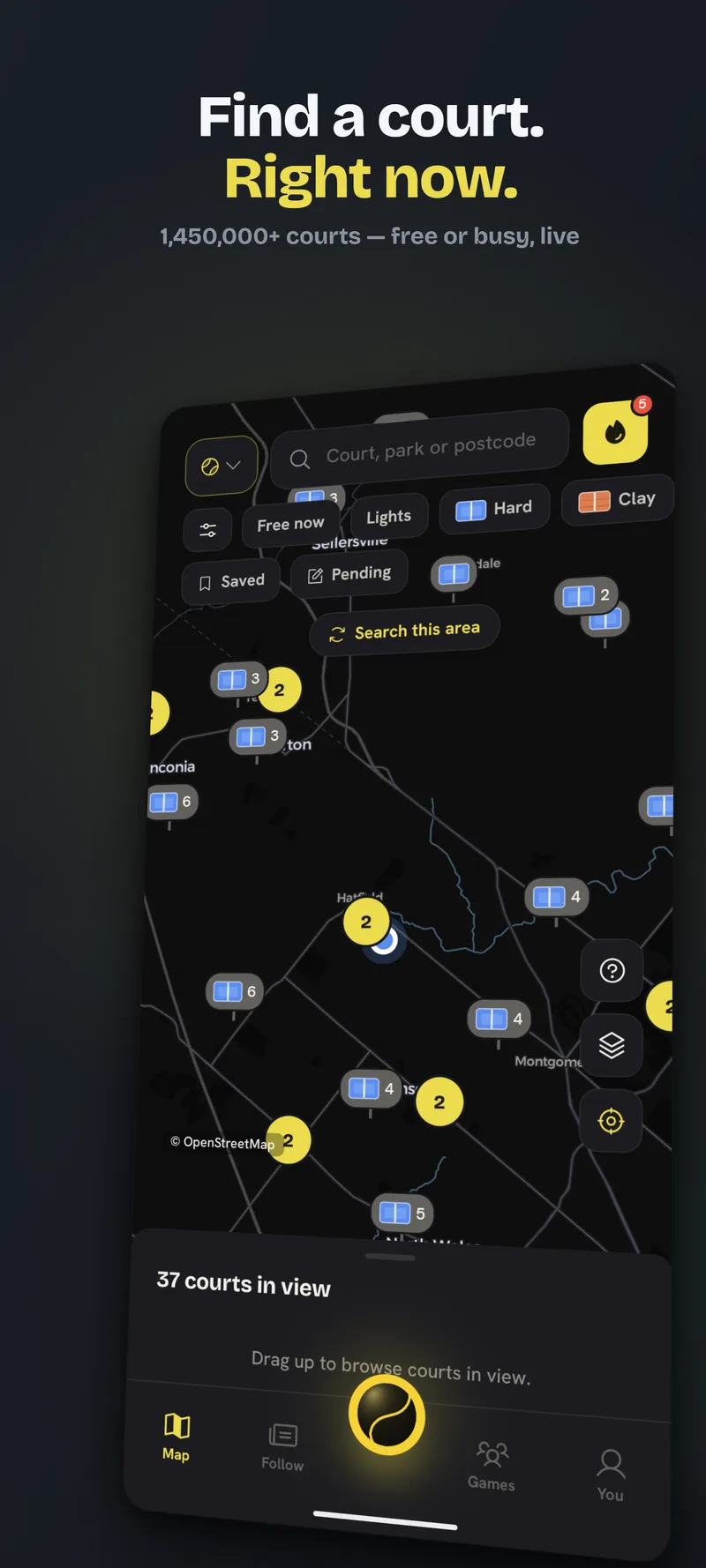
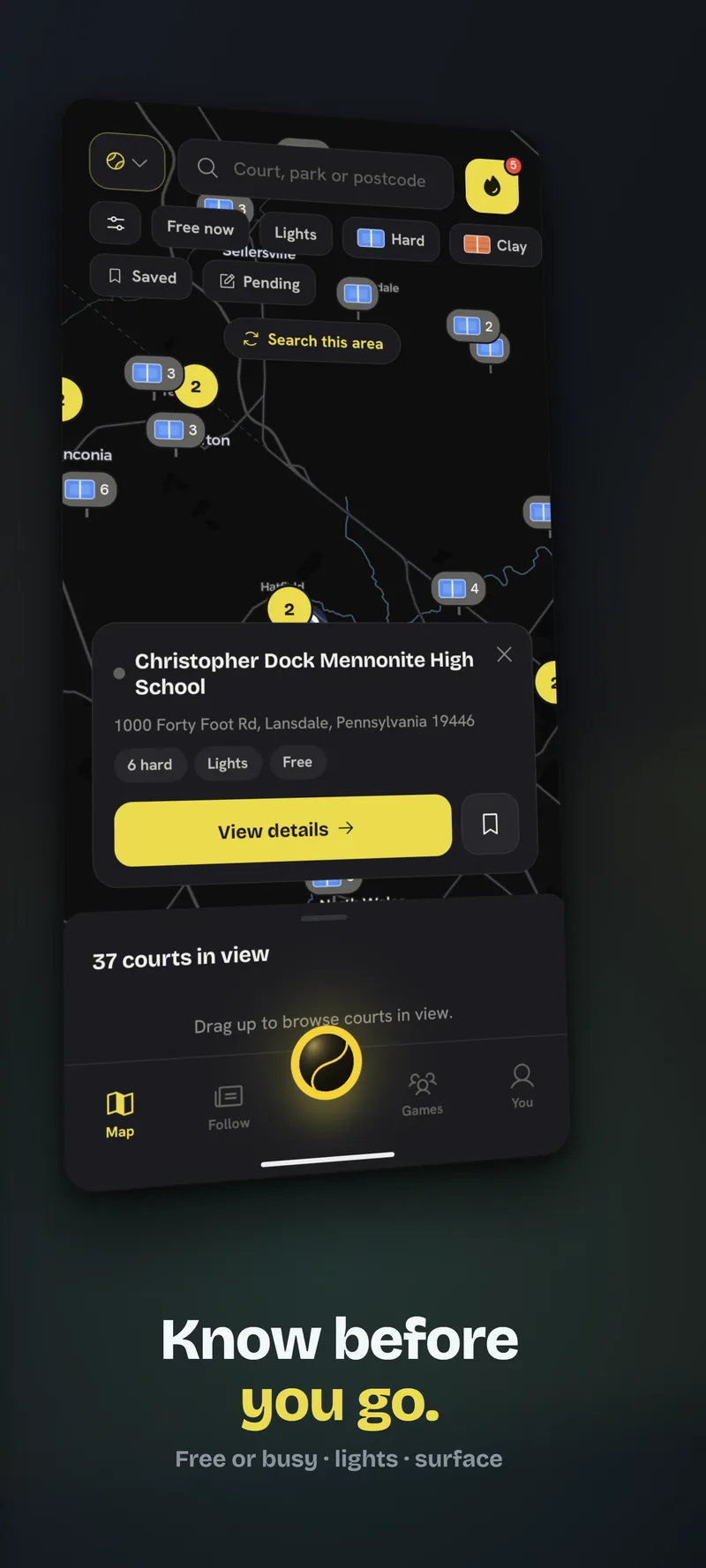
Every court and field is a point with a PostGIS geometry. "37 courts in view" and the "search this area" button are the same operation underneath: give me the published courts whose location falls inside the map's current bounding box, nearest first. Postgres with PostGIS answers that in one indexed query, exposed to the app as a PostgREST RPC. The core lookup is roughly this:
-- published courts inside the current map viewport, closest first
select *
from courts
where geom && st_makeenvelope(min_lng, min_lat, max_lng, max_lat, 4326)
  and status = 'published'
order by geom <-> st_centroid(
  st_makeenvelope(min_lng, min_lat, max_lng, max_lat, 4326)
);
The && bounding-box operator hits the spatial index, so the query stays fast whether the viewport holds four courts or four hundred.
Where 1.45 Million Courts Come From
Rally launched with about 37,000 courts, seeded from OpenStreetMap one country at a time through the Overpass API. Overpass is a shared public good and it behaves like one under load: it rate-limits per IP and rejects large requests outright, so sweeping 243 countries is a bad idea for everyone involved. Querying a whole-planet OSM index instead turned the sweep into a single query per sport.
Getting the rows is the easy half. OSM maps individual courts, not venues, so a tennis club with eight courts arrives as eight shapes and would render as eight pins stacked on top of each other. Collapsing them into one pin that knows it has eight courts is a clustering problem, and the naive version quietly under-merges any court row longer than the clustering radius. Deduplication also has to stay within a sport: a tennis court and a soccer pitch sharing a park are two real places, not a duplicate.
OpenStreetMap gives the coverage. Overture Places and official open-data censuses layer names, addresses, surfaces, and lighting on top, with the richer source winning a shared venue. Anything still unnamed gets a reverse-geocoded one, so you see "Shibuya Tennis Court #3" instead of a bare pin.
Then the Map Got Too Big for One Query
Forty times the data broke two assumptions at once. Zoomed out over a country, the bounding-box query is asked to return hundreds of thousands of rows nobody wants to see individually, and every one of those reads hits the same Postgres instance that also serves check-ins, ledgers, and auth.
Both problems have the same shape: the court catalog is large, static, and identical for every user, while the live status layered on top is small and personal. So the read path splits along that seam. The static catalog is mirrored into a Cloudflare D1 database the worker reads at the edge, with the zoomed-out counts precomputed so a country-wide view is a lookup instead of an aggregation over a million rows. Writes, auth, and anything user-scoped stay on Supabase.
The discipline that makes this safe rather than clever is that the mirror is never allowed to become a second source of truth. Postgres still owns the data, a stale row at the edge is a cache miss rather than data loss, an edge failure falls back to Postgres instead of taking the map down, and switching the whole thing off is a config change rather than a deploy. Because the app only ever talks to the proxy, none of it required shipping an app update.
Nine Sports, One Map
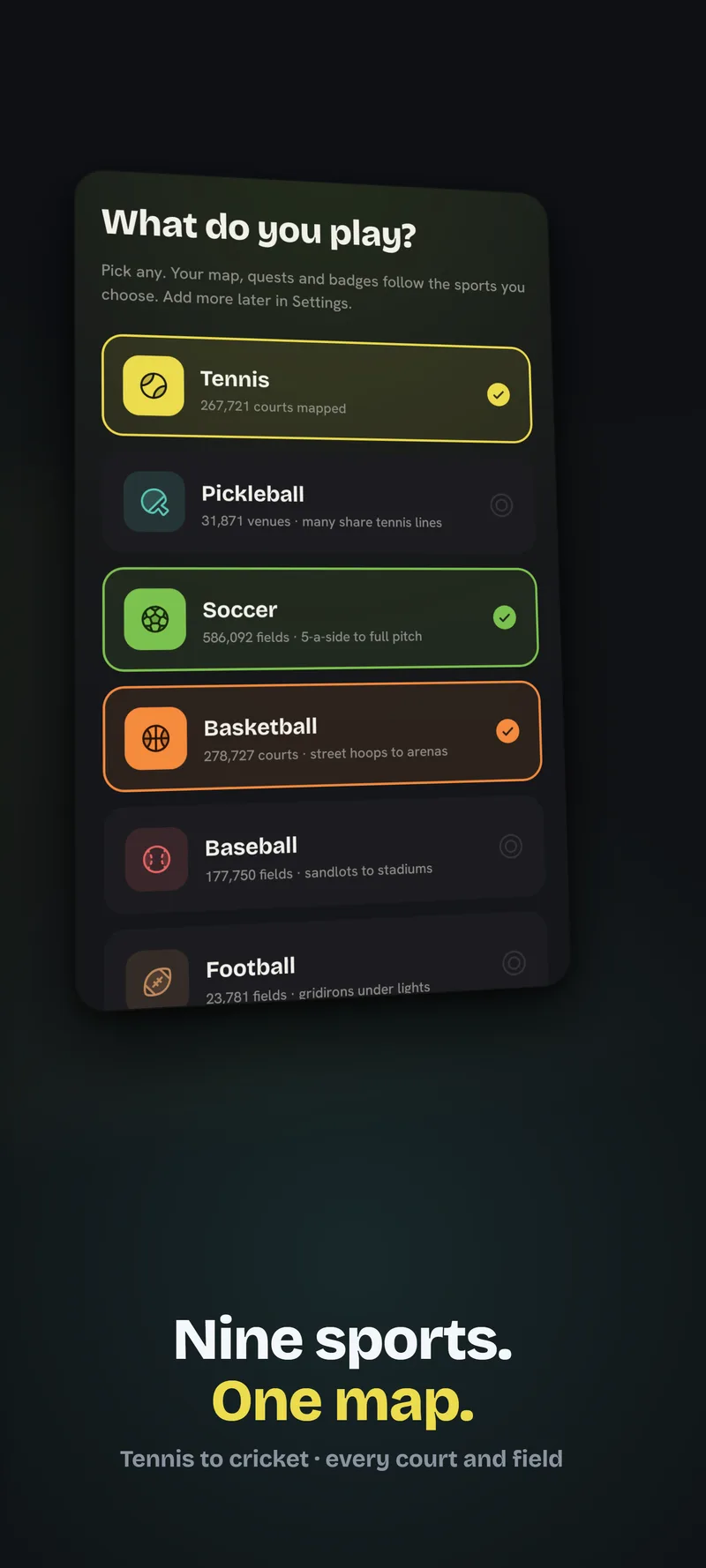
Rally started as a tennis app with pickleball and soccer along for the ride. It now covers nine: tennis, pickleball, soccer, basketball, baseball, football, volleyball, badminton, and cricket, each with its own attributes, so a soccer pitch can say whether goals are provided and a tennis court can say hard, clay, or grass. Your picks drive the map, the quests, and the badges you earn.
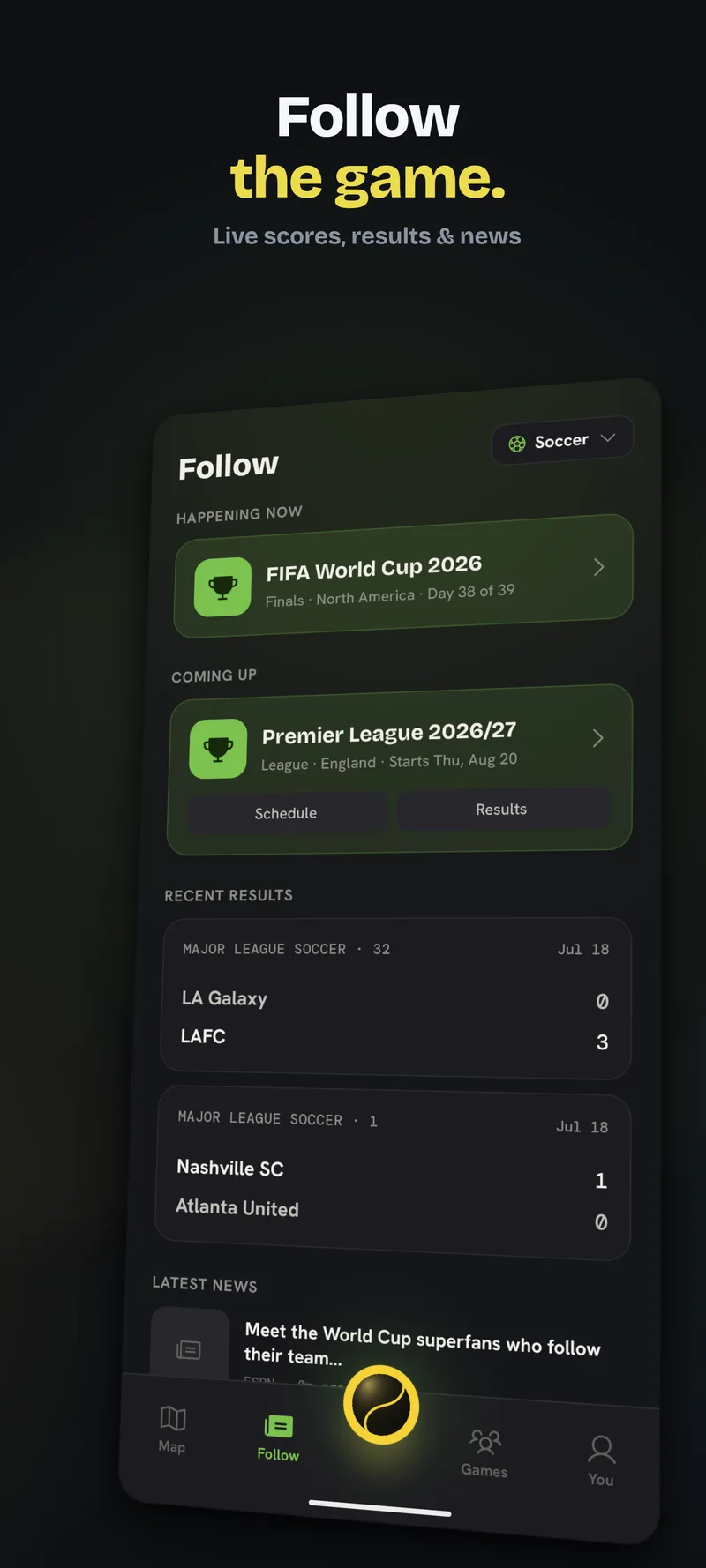
The same expansion pushed a Follow tab into the app: live scores, results, a majors calendar, and per-sport news. It's the one part of Rally that isn't crowdsourced, and it exists because the app already knows which sports you care about.
Keeping the Map Honest
This is the part that makes or breaks a crowdsourced app. If anyone can mark any court "free" from anywhere, the status is noise within a week. So reporting is gated on presence, not on having the app open.
Every status report is tied to a proof-of-presence check-in: your GPS has to put you at the court, or you scan a QR code posted on-site. Adding a brand-new court is stricter still. You drop the pin, set the surface, court count, access, and lights, attach a photo, and submit. It stays invisible to everyone else until two other players independently confirm it on the ground. One account can't spam courts into existence, and one bored person can't quietly flip a busy court to free.
The Phone Never Owns the Score
Points have real value in Rally. XP moves you up the ranks (Rookie, then Scout, and up from there), Aces are a currency you spend in a rewards store, and there are seasonal leaderboards. The moment something has value, someone will try to get it for free, and the baseline attacker isn't tapping through your UI. They're running curl with a valid token.
So the rule is blunt: the client can request an award, it can never grant one. XP and Aces are written only by server-side functions that first verify the check-in's GPS and the per-user rate limit. Row-level security is on every table, so even a hand-crafted request can only ever touch the caller's own rows.
-- the ledger is readable by its owner and writable by no client
alter table xp_ledger enable row level security;

create policy "read own ledger" on xp_ledger
  for select using (user_id = auth.uid());

-- there is deliberately no client insert or update policy.
-- awards are written by a security-definer function the worker calls,
-- after it has checked presence and rate limits.
The full set of rails is small and boring on purpose:
| Guard | What it stops |
|---|---|
| GPS or QR proof-of-presence on every check-in | Reporting a court's status from your couch |
| Two independent on-site confirmations to publish | One person spamming fake courts onto the map |
| Awards written only by server-side functions | Minting XP or Aces with a crafted API call |
| RLS on every table | Reading or writing another player's data |
| Per-user rate limits on costed actions | Scripted floods farming points |
None of this is visible to a normal player, which is the whole point. It should feel like a game and be tedious to cheat.
Gamification Is the Data Strategy
The unglamorous truth of any live-data product is that someone has to keep updating it, forever. Waze solved that for traffic by making reporting feel like play. Rally borrows the idea directly. Daily quests pay out XP for checking in and adding courts. Streaks reward showing up two days running. Badges, ranks, and a seasonal Aces tally turn "keep the map fresh" into something with a scoreboard attached.
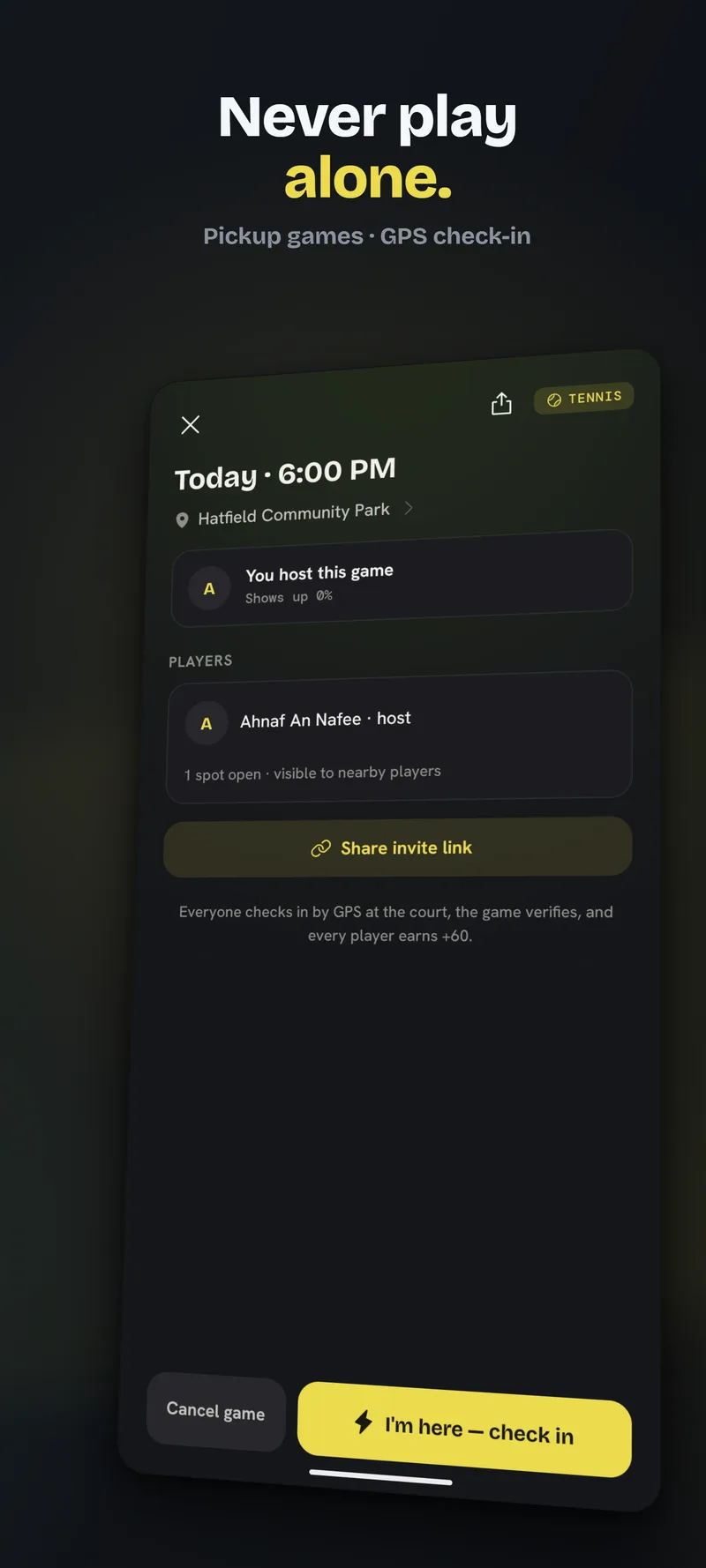
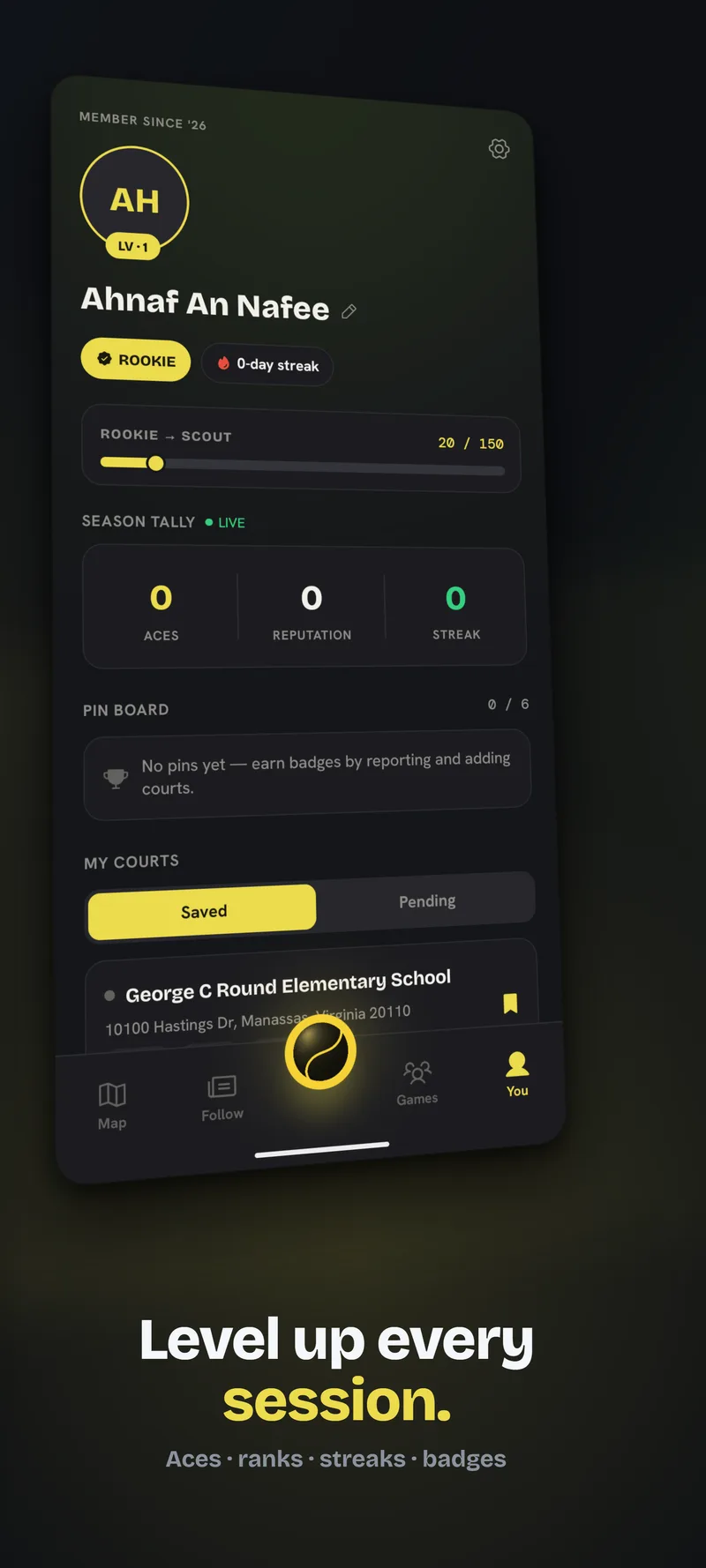
The gamification is the incentive layer, not a growth-hack bolt-on. It's what produces the fresh data the rest of the app depends on. Take it out and Rally is just another directory that goes stale.
What's Deliberately Simple
A few things are v1-simple on purpose. Live status is polled, not streamed: the map refetches, it doesn't hold a websocket open. Court data you've already browsed is cached on-device for a week, which doubles as the offline story without a sync engine. Maps run on MapLibre over Carto vector tiles, so there's no Google Maps or Mapbox SDK to lock into or pay per-load. Rally Pro, the subscription, goes through RevenueCat, with the entitlement verified server-side instead of trusted from a receipt on the phone.
The map was the easy part. The real work was letting strangers edit it without wrecking it, and making the edits feel worth doing. Rally is live at rally.ahnafnafee.dev.

Rally in motion: court map, live status, pickup games, and player progress.