Scaling Education: A Strategy Pattern Approach to Grading at Scale
Deep dive into building a scalable autograder using Python, Java, and the Strategy Pattern. Learn how we can automate grading for hundreds of students using "Frankenstein" code stitching, dynamic rubrics, and local LLMs.

Grading programming assignments provides a unique sandbox to experiment with software architecture. It presents a classic engineering challenge: how can we build a system that is both flexible enough to handle diverse assignments and robust enough to run at scale?
This article explores a hobby project of mine where I attempted to engineer a solution using the Strategy Pattern, "Frankenstein" code instrumentation, and Local LLMs. The goal was to see if modern software patterns and local AI could create a "universal" grading engine.
The Architecture: Python Conductor, Java Engine
The core philosophy is simple: Python orchestrates, Java executes.
We use Python for its flexibility in file manipulation, process management, and API interactions. Java is used strictly for running the student's code against JUnit tests.
The Strategy Pattern
The biggest challenge in building a "universal" grader is that every assignment is different. Some require graph traversal, others list manipulation, and some need strict time complexity checks.
Instead of writing a massive if-else block, I used the Strategy Pattern. We define a Parent Strategy (GradingStrategy) that acts as the blueprint. It enforces a contract that all assignments must follow, while also providing shared utility methods (like code preprocessing and penalty calculations) that child strategies can inherit.
# core/grading_strategy.py

from abc import ABC, abstractmethod

# The Parent Strategy
class GradingStrategy(ABC):
    @property
    @abstractmethod
    def assignment_name(self) -> str:
        """Name of the assignment (e.g., 'GraphAssignment')"""
        pass

    @property
    @abstractmethod
    def rubric(self) -> dict:
        """
        Dynamic rubric mapping.
        Keys are test names, values are points.
        """
        pass

    # Shared logic inherited by all child strategies
    def preprocess_code(self, source_code: str) -> str:
        """Optional hook to modify student code before compilation."""
        return source_code
# core/strategies/graph_strategy.py

class GraphSearchStrategy(GradingStrategy):
    @property
    def assignment_name(self) -> str:
        return "GraphSearch"

    @property
    def rubric(self) -> dict:
        # Maps JUnit test names to point values
        return {
            "testBFS": 15,
            "testDFS": 15,
            "testDijkstra": 20,
            "testEdgeCases": 5
        }

    def preprocess_code(self, source_code: str) -> str:
        # Specific to this assignment: Remove student's main method
        # to prevent it from conflicting with our test harness
        return re.sub(r"public static void main.*?}", "", source_code, flags=re.DOTALL)
This structure allows the main engine (universal_grader.py) to be completely agnostic of the assignment details. It treats every assignment as just a generic GradingStrategy.
The "Frankenstein" Method
One of the most complex parts of autograding is testing private methods or ensuring students follow specific implementation details without exposing our test logic.
To solve this, I implemented what I call the "Frankenstein" Method. We don't just compile the student's file; we surgically alter it.
In universal_grader.py, we extract specific methods from the student's submission and stitch them into a "Frankenstein" class that contains our test harnesses. Crucially, we use regex to flip visibility modifiers so we can test private helper methods directly.
# core/universal_grader.py

def _create_frankenstein_file(self, content_buffer, student_code):
    # ... imports and class definition ...

    # The "Frankenstein" Logic: Force visibility to public
    # This allows JUnit to access private helper methods directly
    public_code = re.sub(r"private\s", "public ", student_code)
    public_code = re.sub(r"protected\s", "public ", public_code)

    # Track line number offset to map compiler errors back to student's original file
    self.line_offset = len(content_buffer.splitlines())
    content_buffer += f"\n// --- STUDENT CODE START ---\n{public_code}\n"

    return content_buffer
This allows us to maintain strict interface requirements for students (private void helper()) while having full access to test those internals during grading. We also maintain a line offset map so if the compiler fails on line 150 of the Frankenstein file, we can tell the student the error is actually on line 20 of their submission.
Dynamic Compilation & Loading
We compile everything locally in a sandboxed temporary directory to prevent pollution. The system dynamically builds the classpath based on the assignment's needs. We use Python's subprocess with a timeout to catch infinite loops (a common issue in student code).
# core/universal_grader.py

# Dynamic Classpath Construction
self.base_jars = ["junit-4.13.1.jar", "hamcrest-core-1.3.jar"]
extra_jars = getattr(self.strategy, "extra_jars", [])

# Constructing the javac command
# Note: We use ';' separator for Windows, ':' for Linux
classpath = ";".join([".", *self.base_jars, *extra_jars])

cmd = ["javac", "-cp", classpath, student_file, tester_file]

try:
    result = subprocess.run(
        cmd,
        cwd=self.temp_dir,
        capture_output=True,
        text=True,
        timeout=10 # Kill compilation if it freezes
    )
    if result.returncode != 0:
        # Handle compilation error...
        pass
except subprocess.TimeoutExpired:
    self.record_error("Compilation Timed Out")
AI-Assisted Grading with Local LLMs
While JUnit captures functional correctness, it fails at semantic analysis.
- Did the student comment their code?
- Is the variable naming descriptive?
- Did they explain their logic in the header?
To catch these, I integrated a Local LLM (Mininstral 3B) running on a local server. When a submission needs semantic checking, we send the code snippets to the LLM with a strict JSON system prompt.
# utils/llm_utils.py

SYSTEM_PROMPT = """
You are a strict grader for a Computer Science course.
Analyze the source code provided.
Output strictly valid JSON with no markdown formatting.
Schema:
{
    "present": boolean, // Is the required info present?
    "feedback": string // Brief feedback for the student
}
"""

def check_student_info(header_text: str) -> dict:
    payload = {
        "model": "mininstral-3b",
        "messages": [
            {"role": "system", "content": SYSTEM_PROMPT},
            {"role": "user", "content": f"Check for Student Name/ID in:\n{header_text}"}
        ],
        "temperature": 0.1 # Low temp for deterministic outputs
    }

    response = requests.post("http://localhost:3002/v1/chat/completions", json=payload)
    raw_content = response.json()['choices'][0]['message']['content']

    try:
        # Validation Loop: Ensure we got valid JSON back
        return json.loads(raw_content)
    except json.JSONDecodeError:
        # Fallback or retry logic...
        return {"present": False, "feedback": "Error parsing AI response"}
This hybrid approach gives us the best of both worlds: the precision of unit tests and the semantic understanding of LLMs, without sending student data to external cloud providers.
Automating the Last Mile
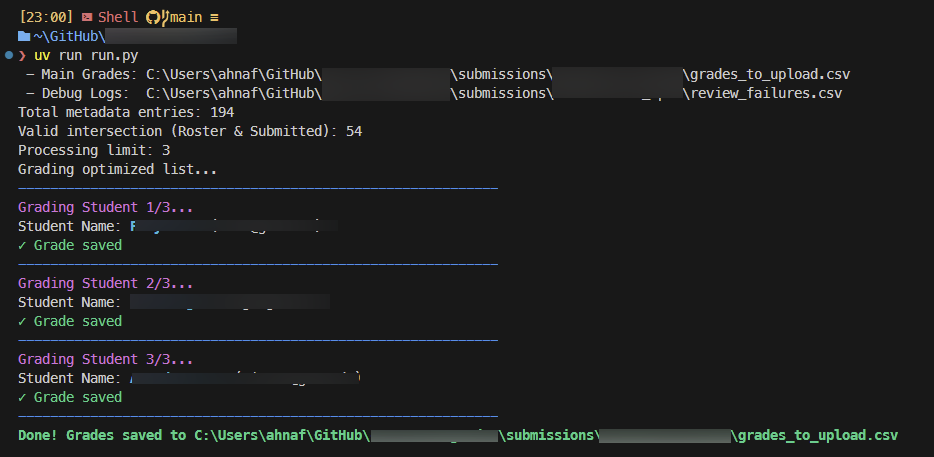
The final step is getting grades into the system. Manually entering thousands of grades is error-prone.
I built a Playwright bot that:
- Reads the final CSV report generated by the
UniversalGrader. - Logs into the grading portal.
- Navigates to each student's submission.
- Fills in the rubric and uploads the detailed feedback file.
import os
import csv
import time
from playwright.sync_api import sync_playwright
from dotenv import load_dotenv

# Load credentials
load_dotenv()
EMAIL = os.getenv("GRADESCOPE_EMAIL")
PASSWORD = os.getenv("GRADESCOPE_PASSWORD")

def main():
    with sync_playwright() as p:
        browser = p.chromium.launch(headless=False)  # Visible browser
        context = browser.new_context()
        page = context.new_page()

        # 1. Login
        print("Logging in...")
        page.goto("https://www.gradescope.com/login")
        page.fill("input[name='session[email]']", EMAIL)
        page.fill("input[name='session[password]']", PASSWORD)
        page.click("input[type='submit']")
        page.wait_for_selector("text=Your Courses", timeout=10000)

        # 2. Grading Loop
        print(f"Reading CSV: {CSV_FILE}...")
        # ... read csv logic ...

        for row in rows:
            student_email = row.get("Email")

            # Resilience: Ensure we are on the right page
            if page.url != review_grades_url:
                page.goto(review_grades_url)

            # Search and Navigate
            page.get_by_placeholder("Search").fill(student_email)
            page.get_by_role("link", name=student_name).first.click()

            # Robust Rubric Selection
            def ensure_rubric_item(name_or_index, desired_state=True):
                btn = page.get_by_role("button", name=name_or_index)
                if btn.get_attribute("aria-pressed") != str(desired_state).lower():
                    btn.click()

            # Grade Question 2
            page.get_by_role("link", name="2:").click()
            if float(row.get("Q2 Score")) == 1.0:
                ensure_rubric_item(1, True)

            # Submit
            # ... submission logic ...
Conclusion
By treating grading as a software engineering problem, we turned a multi-day ordeal into a process that takes minutes. The combination of the Strategy Pattern for extensibility, Frankenstein code manipulation for deep testing, and Local LLMs for semantic checks creates a robust, scalable system that serves hundreds of students efficiently.